%20Finalized%20Logo%20Assets/Logo%20+%20Text/Primary.png?width=400&height=149&name=Primary.png "Extension of Stay")
Your current I-20 date still controls
Your current program end date continues to govern, up to four years from the effective date.
On July 17, 2026, DHS published the final rule that ends "Duration of Status" for F-1 students. It takes effect around September 15, 2026. Here is everything that changes — in plain English, without the rumors.
For decades, F-1 students were admitted for Duration of Status, or D/S, without a fixed end date on the I-94. The new framework replaces that open-ended system with a hard admission date and a formal federal extension process.
D/S is being replaced by a fixed admission period.
Under the former system, an active SEVIS record allowed an F-1 student to complete a degree, extend a program, or begin another program without first filing an Extension of Stay request with USCIS.
DHS proposed replacing D/S in August 2025, received nearly 22,000 public comments, and adopted almost everything it proposed in the final rule.
Important for F-1 Students
In addition to creating a fixed admission period, the new framework introduces restrictions that limit switching schools, changing majors, and moving between degree levels.
F-1 students were admitted for Duration of Status without a fixed I-94 end date while they maintained an active SEVIS record.
The new system gives students a fixed admission period with a hard end date shown on the I-94.
The rule applies to F academic students, J exchange visitors, and I foreign-media representatives. This guide focuses on F-1 students.
The final rule was published in the Federal Register on July 17, 2026, and takes effect 60 days later, around September 15, 2026.
See the rule in DHS's own words
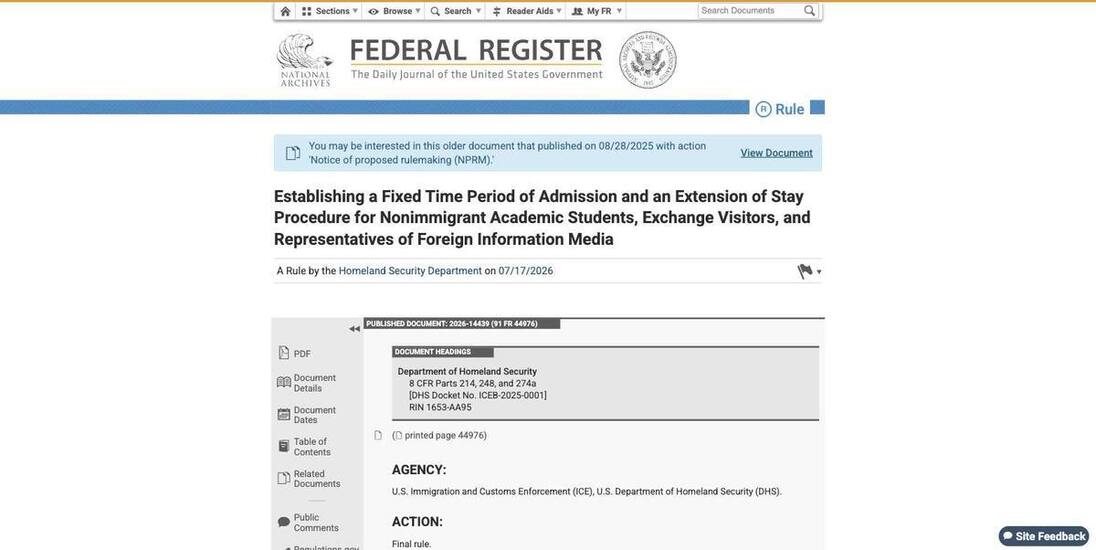
The official record. The final rule as published in the Federal Register (Doc. 2026-14439, 91 FR 44976), a rule by the Department of Homeland Security, 07/17/2026.
What this means for your F-1 status
Your I-94 now has a fixed end date. Staying longer generally requires Form I-539, while new rules limit school, major, and degree-level changes.
Two major developments changed the picture: a federal lawsuit challenged the rule, and DHS and USCIS published detailed implementation guidance. The court has since paused implementation while the case continues.
On August 18, 2026, a coalition that includes NAFSA, the Presidents’ Alliance on Higher Education and Immigration, AICUM, the American Federation of Teachers, and other education and labor organizations filed suit in the U.S. District Court for the District of Massachusetts. The plaintiffs argue that DHS violated the Administrative Procedure Act and asked the court to prevent the fixed-admission rule from taking effect.
On September 14, 2026, the court granted nationwide preliminary relief and postponed the rule’s effective date while the litigation continues. For now, the existing Duration of Status framework remains in place.
What to do now: Continue planning under the existing D/S framework unless the court or DHS changes the status. USCIS says it is continuing to accept the current editions of Form I-539 and Form I-765 and is not accepting the 09/15/26 editions while the injunction remains in effect. Recheck official guidance before filing, traveling, or making a status-sensitive academic decision.
The agencies published detailed guidance before the court paused the rule. That material still explains how the fixed-date system was designed to work, but implementation is currently on hold.
SEVP’s official FAQ on Study in the States, last updated August 31, 2026, explains the proposed “Admit Until Date,” Extension of Stay filing, transition rules, and other practical questions for F students and DSOs.
USCIS originally announced 09/15/26 editions of Form I-539 and Form I-765 with no grace period. After the September 14 court order, USCIS updated its instructions: it continues to accept the prior editions and is not accepting the 09/15/26 editions while implementation is paused.
Use the agency guidance as reference, not as a signal that the rule is currently active. The existing D/S rules remain operative unless the court order changes.
See the rule in DHS's own words
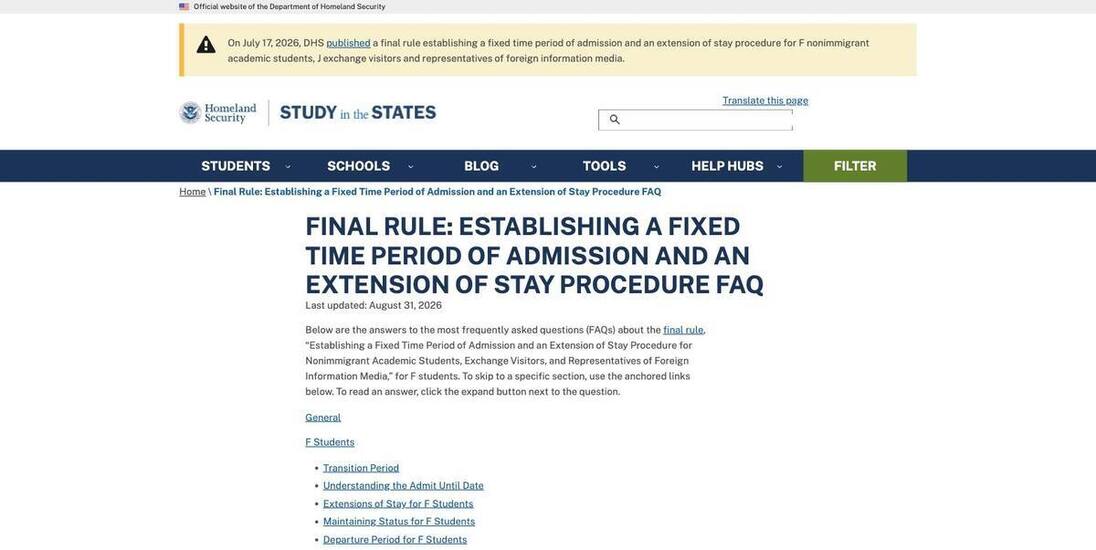
Straight from DHS. SEVP's official FAQ for the final rule on Study in the States — last updated August 31, 2026. The clarifications in this guide come from this document.
Use these dates as decision gates. Your personal I-20, I-94, travel, and filing dates determine how the transition rules affect you.
Final rule published
The rule was published in the Federal Register, beginning the 60-day period before implementation.
Expected effective date
Actions completed before this date generally use the current, simpler process. The new framework applies after this date.
OPT transition reprieve ends
Timely post-completion OPT or STEM OPT filings submitted by this date may use Form I-765 without a separate Extension of Stay filing.
Restriction-delay authority expires
DHS authority to delay or suspend the school-change and educational-objective restrictions expires.
Outer transition limit
This is the outer transition limit for students originally admitted under Duration of Status.
Why the next 60 days matter: Transfers, new programs, and program changes completed before the expected effective date may still follow the current SEVIS-based process.
Which transition window applies to you?
Share one or two dates from your transfer, program, OPT, travel, I-94, or filing timeline.
These are the changes most likely to affect daily planning and status maintenance for F-1 students under the fixed-admission framework.
Change 01
Fixed date
Admission is tied to your program length, capped at four years, with a 30-day window before the program begins and 30 days after it ends.
If the program lasts longer than the admission period, additional time must be requested through USCIS.
Change 02
Form I-539
You generally file Form I-539, pay the filing fee, may attend biometrics, and wait for a discretionary USCIS decision with no administrative appeal.
A timely filing may allow continued study and certain authorized employment for up to 240 days while USCIS decides.
Change 03
30 days
After completing a program or OPT, you have 30 days to depart, change status, or begin an eligible next step—half the former 60-day period.
Early completion or withdrawal starts the clock from the actual end date, not the date printed on the I-20.
Change 04
Higher risk
With a fixed I-94 date, unlawful presence can begin accruing the day after the authorized admission period expires.
Accrued unlawful presence may trigger three-year or ten-year bars on returning to the United States.
Change 05
Movement limits
New restrictions affect first-year transfers, graduate-program changes, and second programs at the same or a lower degree level.
These movement restrictions are addressed in greater detail in the next section.
Which operational change affects your next step?
Ask about fixed dates, Form I-539, the 30-day grace period, overstay exposure, or the new restrictions on schools, majors, and degree levels.
Review each rule to see what it controls and the exception language described in the supplied guide.
|
Rule
|
What it means
|
Possible exception
|
|---|---|---|
| First year, first school | Below graduate level, complete the first academic year at the school that issued the initial I-20 before transferring or changing the educational objective. | SEVP may authorize extenuating-circumstances exceptions. |
| Graduate students locked in | At the master's level or above, major changes are prohibited and transfers during the program are generally prohibited. | SEVP may allow transfer exceptions for extenuating circumstances; there is no stated major-change exception. |
| No same- or lower-level second program | After completing a program, the next program must be at a higher educational level. | Prospective only: it applies when the current program is completed after the effective date. |
Which academic movement rule applies to you?
Share your current degree level, completion date, and intended school, major, or program move.
The final rule preserved the architecture while adding targeted clarifications and limited softenings.
|
Topic
|
Proposal
|
Final rule
|
|---|---|---|
| Graduate transfers | Prohibited without exception. | Still prohibited, but SEVP may allow extenuating-circumstances exceptions. |
| Same/lower-level ban | Retroactivity unclear. | Prospective only, based on when the current program is completed. |
| DHS delay authority | No time limit. | Expires two years after the effective date; delays must be published in the Federal Register. |
| OPT start-date window | Still referenced 60 days. | Corrected to 30 days to match the new grace period. |
| Post-completion OPT | Pathway ambiguous. | Travel and re-enter through CBP, or file an Extension of Stay with USCIS. |
| Early completion | Not addressed. | Thirty days from the actual end date. |
Which parts of the final rule affect your situation?
Ask us to identify what is final, what is transitional, and what still needs an official update.
Current D/S students receive meaningful transition protection, but extensions, new programs, and international travel can bring the new fixed-date system into play.
Your current program end date continues to govern, up to four years from the effective date.
Transition students keep the prior 60-day grace period after completing the current program.
Leaving the United States and returning can convert your admission to the new fixed-date framework.
Timely post-completion OPT or STEM OPT filings on or before approximately March 18, 2027 may require only Form I-765.
Transition students may file an Extension of Stay when the current authorized period runs out.
Your I-94 date is about to become the most important date you own. The free OPTimize app by GoElite tracks your I-94 expiry, your USCIS case status, and your OPT timeline in one place — with alerts before every deadline.
Share whether you are mid-program, on OPT, planning travel, or preparing to begin a new program.
The rule does not eliminate Day 1 CPT. It changes the surrounding fixed-date, Extension of Stay, degree-level, transfer, and academic-standing framework.
What the Rule Says
Day 1 CPT remains available, but the academic and immigration framework surrounding it becomes more restrictive.
Day 1 CPT is not eliminated. The rule does not prohibit Day 1 CPT or make substantive changes to CPT itself.
The second master’s pathway narrows. A same-level second program is generally unavailable when the current program is completed after the effective date.
CPT must fit the admission period. When a program extends beyond the I-94 date, an approved or timely filed Extension of Stay becomes central.
Academic standing matters more. Academic probation, suspension, and repeated failure to complete coursework are generally unacceptable reasons for an extension.
Enrollment timing changes the options. A transfer or new program completed before the effective date may remain under the current SEVIS-based process.
What the Rumor Claims
These statements oversimplify or misrepresent what the rule changes.
“The rule bans Day 1 CPT.” The rule does not eliminate Day 1 CPT.
“The second master’s route stays unchanged.” Same-level study becomes more restricted after the effective date.
“CPT can continue past the I-94 date without EOS.” The fixed admission period makes the I-94 date a controlling deadline.
“Academic standing does not affect an extension.” Poor academic standing may undermine the basis for requesting additional time.
“Enrollment timing makes no difference.” Completing a transfer or beginning a new program before the effective date may preserve more options.
Ask about degree level, program completion, enrollment timing, academic standing, CPT, or Extension of Stay exposure.

Choose the situation that best matches your current stage to review the dates, filings, travel considerations, and next steps that may matter most.
Graduating soon
OPT / STEM OPT
Mid-program
Everyone
Share whether you are graduating soon, mid-program, on OPT, planning travel, or preparing to begin a new program.
The rule governs your period of admission (your I-94), not your visa stamp. Your visa can expire while your admission remains valid, as before — but your I-94 end date now controls how long you may stay.
If you're admitted at the border before the effective date, you enter under D/S and the transition rules protect you. If you enter after ~September 15, 2026, you're admitted under the new fixed-date regime from day one.
Yes — DHS gave itself authority to delay or suspend the transfer/objective restrictions, announced via the SEVP website and the Federal Register. That authority expires 2 years after the effective date. Don't plan around a delay that hasn't been announced.
Major rules like this often draw litigation, and the rule is also subject to congressional review. As of publication, the rule is scheduled to take effect on time — we'll update this guide if that changes.
Cap-gap rules are substantively unchanged, and DHS made no substantive changes to CPT (including Day 1 CPT). The rule is about admission periods and extensions, not work-visa categories.
Sources
-3.png)