%20Finalized%20Logo%20Assets/Logo%20+%20Text/Primary.png?width=400&height=149&name=Primary.png "Extension of Stay")
Start the DSO conversation 3–4 months ahead
The updated I-20 must come before the USCIS filing.
Under the new rule, extending your F-1 stay is no longer a note in SEVIS—it is a formal USCIS filing. Here is who needs to file Form I-539, when, and exactly how, with the protections that keep you studying and working while you wait.
An Extension of Stay is a formal USCIS request on Form I-539 asking to remain in the United States beyond the end date on the I-94.
Form I-539 asks USCIS to extend your authorized stay beyond the end date shown on your I-94. Your DSO still provides the supporting updated I-20, but USCIS makes the discretionary decision.
This means the school supports the request, while the federal government decides whether the additional period of stay is granted.
Important for F-1 Students
Under the final rule, F-1 admission is tied to a fixed end date rather than open-ended Duration of Status. A student who needs more time must coordinate with the DSO, obtain an updated I-20, and file Form I-539 with USCIS before the authorized stay expires.
A filing fee, supporting evidence, and possibly biometrics at an Application Support Center.
Processing may take months, making the timely-filing protections explained in Section 4 especially important.
No. An Extension of Stay is discretionary, so USCIS may approve or deny the request based on the filing and supporting evidence.
The guide states that a USCIS denial of an Extension of Stay has no administrative appeal.
Need the big-picture explanation first?
Start with the rule-change guide, or ask someone on our team to explain how the fixed-date rule affects your next step.
An Extension of Stay is a formal USCIS request on Form I-539 asking to remain in the United States beyond the end date on the I-94.
Example: your admission covers four years, but your PhD needs six.
An Extension of Stay may bridge the gap unless you depart and re-enter with the new I-20.
This can happen when transitioning into a new academic program.
During the transition window, a timely Form I-765 may be enough. After that, an Extension of Stay or travel and re-entry may generally be needed.
An Extension of Stay is generally not needed if you depart within the 30-day departure period.
There may be nothing to submit yet, but your current and future dates still need careful tracking.
Need help deciding between filing and travel?
Our team can review your timeline and explain how an Extension of Stay or travel with re-entry may affect your next step.
An Extension of Stay is a formal USCIS request on Form I-539 asking to remain in the United States beyond the end date on the I-94.
Controlling deadline
I-94
File before this date. A timely, non-frivolous filing is what activates the pending-case protections.
Start the DSO conversation 3–4 months ahead
The updated I-20 must come before the USCIS filing.
The final six months are a sensible filing window
Avoid both an absurdly early request and a last-week scramble.
Track the actual completion date
Early completion starts the 30-day departure clock from the real end date.
Do not plan on a late-filing exception
Only extraordinary circumstances beyond your control may be excused.
The final 30 days are still inside your AUD, so an EOS filed during them can still be timely. The catch is that SEVP warns certain employment may have to stop while the case is pending.
File before the 30-day window opens.
This avoids the special employment interruption that applies when the EOS is filed during the departure period.
Timely does not mean unchanged.
On-campus work, hardship employment, or CPT may not begin or continue while the EOS is pending, and may resume only if the EOS is approved.
Your actual completion date matters. If you finish your program early, the 30-day clock runs from your actual end date — not automatically from the date printed on your I-20.
See the rule in DHS's own words
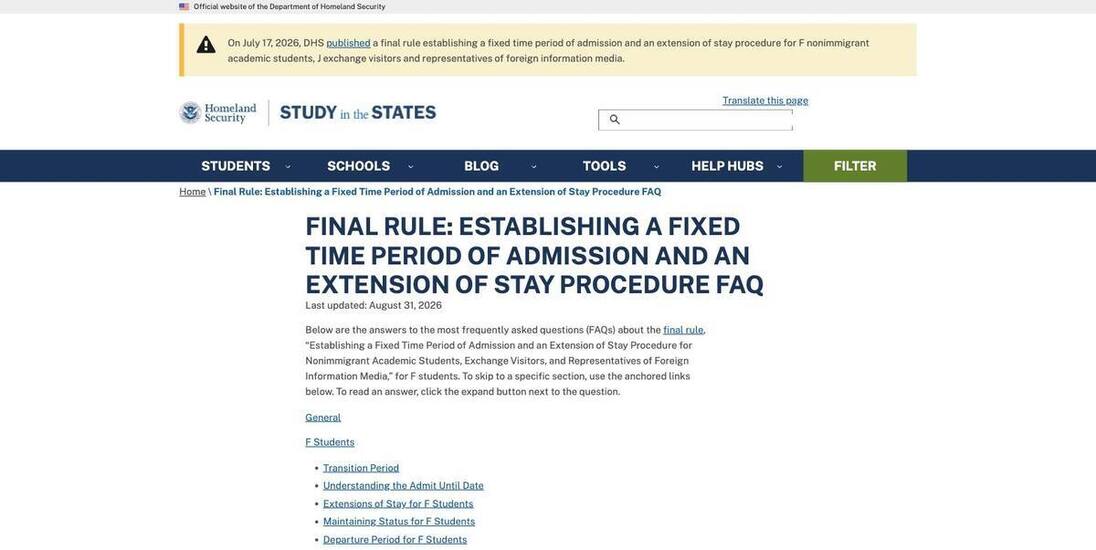
Straight from DHS. SEVP's official FAQ, last updated August 31, 2026, is the source for the AUD math and filing-window rules used in this section.
The free OPTimize app tracks your I-94 / AUD expiry, USCIS case updates, OPT timing, and reminders before a deadline becomes a status problem.
Know your filing window before the deadline gets close.
Review your I-94, program end date, updated I-20, and travel plans so you can identify the right next step without a last-minute filing scramble.
A timely, non-frivolous Extension of Stay filing may provide limited protections while USCIS reviews the request. The exact effect depends on your filing, enrollment, status, and previously authorized employment.
Pending protection
Stay
A timely, non-frivolous Extension of Stay filing may allow you to remain after the end date shown on your I-94.
Continued enrollment
Study
The guide describes how eligible F-1 students may continue studying while USCIS reviews the application.
Work authorization
240 days
Previously authorized CPT and on-campus employment may continue to the applicable limit unless USCIS denies the filing.
Understand what remains protected while your case is pending.
Review how your filing date, I-94, enrollment, CPT, and on-campus employment may interact while USCIS considers your request.
Use this sequence to coordinate with your DSO, prepare Form I-539, assemble the supporting evidence, file before the I-94 deadline, and track the case after submission.
Obtain the supporting I-20 3–4 months before the I-94 date.
Confirm the academic or medical reason fits the rule.
Complete the form consistently with SEVIS and the evidence.
Verify the amount at uscis.gov/i-539 before filing.
Show status, academics, finances, identity, and a clear explanation.
Submit before the I-94 date and retain the I-797C receipt.
Attend or properly reschedule any appointment.
Respond to RFEs and track the new I-94 date after approval.
Use the correct form edition before you file
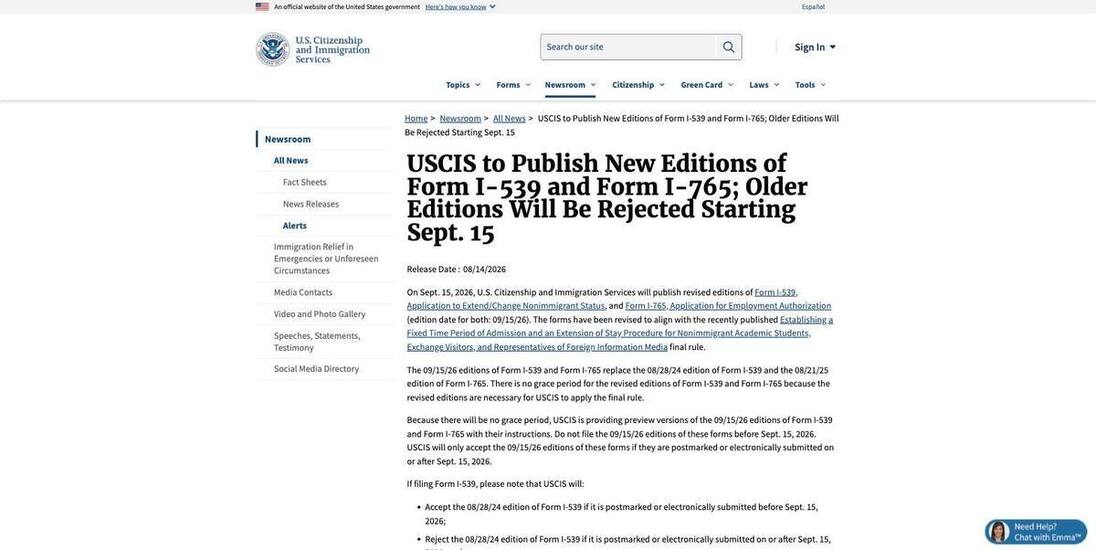
The form-edition rule is official. USCIS announced on August 14, 2026 that the 09/15/26 editions of Form I-539 and Form I-765 replace the prior editions with no grace period. Filing the wrong edition on or after the required date can result in rejection.
You prepare the filing, our AI checks it for completeness, and a licensed attorney reviews the issues that matter. You’ll get a written fix list and an RFE guarantee. Flat fee from $300.
Use this checklist to organize the core application, immigration records, school documents, financial evidence, and supporting materials that may be included with Form I-539.
Complete every required section and sign the application.
Verify the current fee and accepted payment method at uscis.gov/i-539.
Obtain the supporting updated document from your DSO.
Include the latest record showing your authorized admission date.
Ideally valid for at least six months beyond the requested stay.
Include a copy even when the visa stamp has expired.
Show current enrollment and satisfactory academic standing.
Include bank statements or documented sponsor support.
Describe why additional time is needed and the requested period.
Include supporting records for F-2 family members when applicable.
Avoid sending original documents unless USCIS specifically asks.
Make sure your filing package is complete.
Review your Form I-539, updated I-20, I-94, identity documents, financial evidence, explanation letter, and dependent records before submitting.
After USCIS receives the filing, track the receipt notice, attend biometrics if scheduled, respond to any evidence request, and review the final decision carefully.
Proof of timely filing and the case-tracking number.
Missing the appointment may lead to denial.
An RFE is not a denial, but the response deadline is strict.
Approval creates a new I-94 date. A denial has no appeal or grace period in the guide.
Track your receipt number, biometrics appointment, RFE deadline, and final decision so you can respond promptly at every stage.
Timing errors, inconsistent dates, weak evidence, and incorrect assumptions can create avoidable filing problems. Review each issue before submitting Form I-539.
The DSO update may take longer than expected.
The I-94 controls authorized stay.
The USCIS filing is the student’s responsibility.
All records should tell one consistent story.
Show stable and sufficient support.
Both can cause preventable rejection.
The 240-day rule is limited, not blanket permission.
Review your I-94 date, updated I-20, Form I-539, fee, signature, funding evidence, and employment limits before submitting the request.
Compare self-guided preparation, focused attorney guidance, flat-fee review, and full representation based on your case complexity and comfort level.
Level 1
For a clean case and a student comfortable preparing alone.
Level 2
For one focused timing, evidence, travel, or status question.
Level 3
You prepare; an attorney flags issues and gives a written fix list.
Level 4
Independent counsel handles the filing as attorney of record.
Not sure which level is right for you?
Tell us about your timing, evidence, travel plans, and filing concerns to receive a clearer support recommendation.
Processing times vary by service center and change constantly — check current times at uscis.gov. Plan on months, not weeks, which is exactly why the timely-filing protections exist. DHS declined to commit to adjudication deadlines for these applications.
Leaving the U.S. while an I-539 is pending is generally treated as abandoning the application. If travel is on your horizon, get advice before you file about sequencing — this is a classic trap.
No. An EOS extends your authorized stay (I-94), not your visa stamp. If your visa has expired and you later travel, you'll need a new visa to re-enter.
The I-539 filing fee plus a possible biometrics-related cost — check the current amounts at uscis.gov/i-539 before filing, as fees change. Budget separately for any professional help you choose.
Yes — for your next step. If you start a new program or OPT after ~September 15, 2026, the fixed-date regime and this filing apply to that chapter. Understanding it now is how you avoid planning your next move around rules that no longer exist.
Sources